
Cal Poly's Agricultural Legacy at a Crossroads
The Proposed Elimination of Prime Farmland at Cal Poly, San Luis Obispo
Sign the petition to Save Cal Poly SLO Farmland
Update: Sept 23, 2026
Busy day yesterday. Many concerned folks submitted public comments ahead of the CSU Board of Trustees meeting, Dean Brian Horgan sent an email to the students, faculty and staff with an update, and President Armstrong made a big announcement about a massive donation of land out by the SLO airport. More on that announcement coming soon.
You can read the most recent Dean’s email here.
The email was long, light on details, and it contradicted his previous email sent to faculty only earlier this month. In the earlier email, he clearly stated that they have decided to relocate the project across Highland Drive from the existing Crops Unit, within the area currently being discussed as part of the university’s broader West Campus planning.
In the email he sent this week to students, faculty and staff, he says at least 8 times, that no decision has been made, discussions are ongoing. So which is it?
Either way, the major points remain:
They want to remove an active orchard and build a farm store, resulting in a net loss of prime farmland on campus.
As compensation, they want to relocate the orchard to fields with damaged soil, couching that as a learn by doing opportunity. And, they’re assuming the soil can be rehabilitated to safely grow food. Extensive soil testing needs to be done first to determine the feasibility of using that land for food crops.
There’s a lot more to unpack from the Dean’s emailed message. More on that coming soon.
The petition is now at 4,600+ signatures. The message is clear. Do not build on prime farmland.
And in case you missed it:
CAFES is planning a big celebration
125th Anniversary of Cal Poly’s College of Agriculture, Food and Environmental Sciences (CAFES)
A big celebration and fundraising campaign is planned for Cal Poly’s CAFES 125th anniversary.
Get the attention of Armstrong, the CAFES Dean's office, the department advisory councils and anyone else involved with planning or fundraising related to the 125th anniversary. Send emails, or message on LinkedIn:
any of the Plant Sciences Department advisory council members,
the CAFES’s advisory council members,
Dean Brian Horgan (bhorgan@calpoly.edu)
Jeff Armstrong (jarmstro@calpoly.edu)
Many students, parents and alumni are choosing not to attend and not to donate until this issue has an acceptable resolution. If you’ve already paid for tickets or donated, you can ask for your money back.
Update: Sept. 13, 2026
The work continues.
Two impactful steps you can take:
A big celebration and fundraising campaign is planned for Cal Poly’s CAFES 125th anniversary.
Get the attention of Armstrong, the CAFES Dean's office, the department advisory councils and anyone else involved with planning or fundraising related to the 125th anniversary. Send emails, or message on LinkedIn:
any of the Plant Sciences Department advisory council members,
the CAFES’s advisory council members,
Dean Brian Horgan (bhorgan@calpoly.edu)
Jeff Armstrong (jarmstro@calpoly.edu)
Many students, parents and alumni are choosing not to attend and not to donate until this issue has an acceptable resolution. If you’ve already paid for tickets or donated, you can ask for your money back.
2. Contact the CSU Board of Trustees (Armstrong’s bosses)
Submit a 1-minute public comment in-person or online by September 21st
Public comment will take place on Tuesday, September 22, at the start of the Board of Trustees’ open session, scheduled to begin at approximately 11:00 a.m.
Email written comments in advance of the meeting by 12:00 p.m. on Monday, September 21 to trusteesoffice@calstate.edu.
Public comment during the meeting, in-person or virtually/telephonically by providing a written request by 12:00 p.m. on Monday, September 21 to trusteesoffice@calstate.edu or completing the form at Addressing the Board of Trustees. In your request, identify the subject of your comment - Do Not Build on Prime Farmland at Cal Poly, SLO.
The meeting will be broadcast via the livestream through the Board of Trustees website.
Here is the 1-minute comment I plan to submit. Feel free to use this one or write your own.
California loses 47,000 acres of farmland every year, approximately 1 square mile every 5 days on average. It is a problem for CA agriculture and CSU campuses that serve that industry should not be part of the problem. President Jeff Armstrong of Cal Poly San Luis Obispo wants to destroy 54 acres of prime farmland on campus, ignoring previous agreements that protected this land from development, to build a non-academic neighborhood on campus that no one has asked for. This severely weakens student’s expectations for a hands-on learning experience.
Instead - build on already compromised soils and seek innovation and educational opportunities from the design and build programs on campus.
Set the example for land and natural resource stewardship.
Honor your previous commitments and the wishes of the student body and do not build on prime farmland.
End of comment
The Clock Has Started Ticking
The administration is moving forward despite their claims that this is in the discussion phase, and that no decisions have yet been made.
A consultant group, hired by the university, accessed a recently planted orchard on the disputed land to begin looking for architectural or Native American presence of historical significance - one element required for an Environmental Impact Report for building permits.
The Dean’s office has decided, as of Sept. 11, 2026, that the first building to be built on our prime farmland is a farm store with additional structures and activities that would displace the remainder of the current orchard.
Potential Risks and an Impossible Timeline
Their current plan is to remove part of the new orchard, on prime farmland, to build a Cal Poly Farm Store starting in late September. As compensation, they want to simultaneously convert the dairy manure spray fields into a new orchard/crop field.
Their claim that the dairy manure spray fields could one day be used to farm crops for human consumption has no scientific evidence. These fields have been designated for the purposes of spraying manure effluent, and hosting the tractor pull, rodeo, and other events. To now grow crops on this soil, the following must first be assessed:
soil degradation by compaction and salts
soil and water contaminated by pathogens that cause foodborne illnesses
excessive nutrients such as nitrates and/or heavy metals
Catch-22
Gathering these data would take months, if not longer. The university president’s office has created a Catch-22. Armstrong has given the agriculture Dean’s office a deadline of the end of this September to provide a cost estimate for making the spray fields suitable for an orchard and other crops. The information needed to determine if the land can be made safe and productive for food crop production cannot be collected in time.
There is a strong likelihood of soil pollutants in the fields, and it could take years if not decades to remediate those soils. Options for remediation of the soil include leaching contaminants, which may contaminate the water table or nearby Brizzolara Creek, a designated sensitive habitat for endangered and sensitive salmonid species.
Additionally, because the university will begin building right away, hundreds of current students won’t have access to the land needed for their educational laboratories. Students and faculty would have to wait years while an attempt is made to rehabilitate the land and establish a new multi-crop deciduous orchard for teaching, an organic farming research plot, and a lemon orchard large enough to teach students industry-scale skills and conduct industry-focused research projects. Most of these academic activities may not even be possible, therefore, current and future students will not be getting the degree they signed up for and paying steep tuition to receive.
Neither faculty nor students have asked for a farm store. Cal Poly products are already sold by students at local farmers markets and grocery stores throughout the community.
Here’s the kicker. Instead of building it on an empty parking lot across the street, they want to bulldoze a newly planted orchard – part of the 54 acres of prime farmland. The administration is framing this farm store as “agriculture”, which is how they rationalize building on prime farmland.
There is no clear cost savings for building the farm store on prime farmland instead of on an already paved or compacted area, nor has university administration articulated a justification for doing so. Where’s the transparency?
The Dairy Unit
And what is the dairy supposed to do with up to one million gallons of manure effluent they produce in a year? The animal science department and agricultural operations - the faculty and staff who utilize the spray fields - don’t know where the effluent will go. If an alternate location is suggested by the administration, it cannot be assumed that it will be appropriate, safe or that it won’t negatively impact yet another educational program.
The university does not have a plan for what they are eliminating from student curriculum and department operations. They want to get started, build on prime farmland, all without having to answer any questions or explain their rationale.
This statement from a colleague, who wishes to remain anonymous, clearly articulates the frustration:
"I was sad to see the Dean’s email [about the decision to build the farm store on Prime Farmland] this morning. If the college continues building on our farmland, how can we expect anyone to take us seriously when... we need to preserve it to deliver the educational mission.... It feels like the college and university just want to build without any strategic vision or plan, let alone faculty, student and staff input."
Why is Armstrong hiding?
The administration has not responded to face-to-face meeting requests from a group concerned about the proposal to build on prime farmland on Cal Poly SLOs campus.
Cal Poly officials have not held any public meetings or made any public announcements about the building proposal.
Keep calling. Keep emailing. Keep asking for a public meeting to ask questions and hear directly from the proponents of this plan.
Our message is clear. Do not build on prime farmland.
Update: Aug 29, 2026
To date, the petition has acquired 3,000+ signatures and a network of key partners is growing.
The University has developed a standard reply for all inquiries. One claim is that they have done due diligence by engaging all the important stakeholders, and that has directly informed their planning. They say “protecting and strengthening the educational experience of our agriculture students has been a guiding principle throughout this process.”
Who are the important stakeholders? Students or faculty or alumni? The University has not disclosed who exactly they met with or what the feedback was.
What we do know is that they have not consulted with the faculty directly involved in maintaining and teaching on these lands. We also know the University had a meeting with agriculture students in 2025. As a result, the students published a resolution adamantly against building on agriculture lands on campus. Read the ASI resolution #25-07.
So again, who does the University consider to be an “important stakeholder”? Clearly not students if the University is ignoring the resolution.
And how does the elimination of productive orchards on prime farmland protect and strengthen the education experience of our agriculture students? There is deception and flawed reasoning on their part.
Update: Aug 21, 2026
The Tribune published their article today, which was very well done. One of Cal Poly’s consistent talking points is “no net loss” of farmland for agriculture students. The problem is that they are focusing on the quantity of land, but the crucial issue is the quality of land. They are proposing to build on Prime farmland in exchange for land that is only suitable for grazing - land that will not support vegetable crops or fruit orchards that students and faculty use for teaching and research. Non-academic facilities like a hotel, convention center and retail space are not living laboratories and would not preserve or enhance agricultural education. This is a key point that bears repeating.
Update: Aug 15, 2026:
We are encouraged by the overwhelming response from students, parents, alum and the community at large. Many are writing letters, contacting the media, local representatives and leaders in the ag industry are organizing.
If you’re ready to help, here’s what you can do.
Write letters, call or email:
President Jeff Armstrong, jarmstro@calpoly.edu
Brian Horgan, bhorgan@calpoly.edu, the Dean of the College of Agriculture, Food and Environmental Sciences
Tell them to:
Honor the agreement in the Master Plan 2035 that exempts this land from development.
Stop ignoring student resolution #25-07 that formally opposed any development on ag lands.
The proposed “land swap” is insulting. Swapping Prime productive farmland for land that is only suitable for grazing is not an option. We know the difference and we will not be misled.
Non-academic facilities like a hotel, convention center and retail space are not living laboratories and would not preserve or enhance agricultural education. So who exactly would benefit from this?
You can focus your message on any of these talking points that resonate with you the most. Or you can add your own.
Contact your local representatives. Ask them to take action to preserve this non-renewable resource at Cal Poly, San Luis Obispo.
Original Post, August 10, 2026
The US loses nearly a square mile of farmland every day (Conservation Fund 2025). Sometimes these losses occur when farming families have little to no choice. But in the case of Cal Poly, the proposal to eliminate productive agricultural land and lease it to a developer for a hotel and retail space is a choice that has left me dumbfounded, yet again. This is the second time the administration has made such a proposal. The first time in 2015 was supposed to be the last.
Family Farms
Drive up Hwy 101 towards the Bay Area and you’ll pass through some of the most fertile and productive agricultural lands in the world. Yes, the world. The agricultural output of this stretch of land dwarfs the entire output of most US states and of entire nations. It should be a treasured resource. But it is under threat. Along that 101 drive you can see massive structures being built on prime agricultural land. In the Salinas Valley, there’s an Amazon distribution warehouse, and another proposed for Gilroy. Giving up farmland must be difficult for families and businesses. I can only speculate that some reduction is necessary, oftentimes there’s no one else in the family to farm the land, kids move away, retirements, deaths; sometimes it’s a business decision. Land that has been in families for generations, now being paved over is a painful sight for all involved in agriculture, big and small. Once you build on it, you never get it back.
The Proposal
The loss of agricultural land could be happening here right on my home campus of Cal Poly, San Luis Obispo, but for very different reasons. The university’s administration is proposing to build on what is designated as Prime or Class 1 farmland; thereby, eliminating a rare resource used to teach students how to become responsible and innovative leaders in all aspects of agriculture in California and beyond. The heart of our learn-by-doing approach…gone.
Cal Poly’s Master Plan 2035 is intended to guide land development on campus through 2035. By the time it and the environmental impact report were finalized in 2020, new builds on campus were to be concentrated in the campus core and avoid negatively impacting other natural resources. Specifically, 250 acres of Prime farmland that were explicitly excluded from further development.
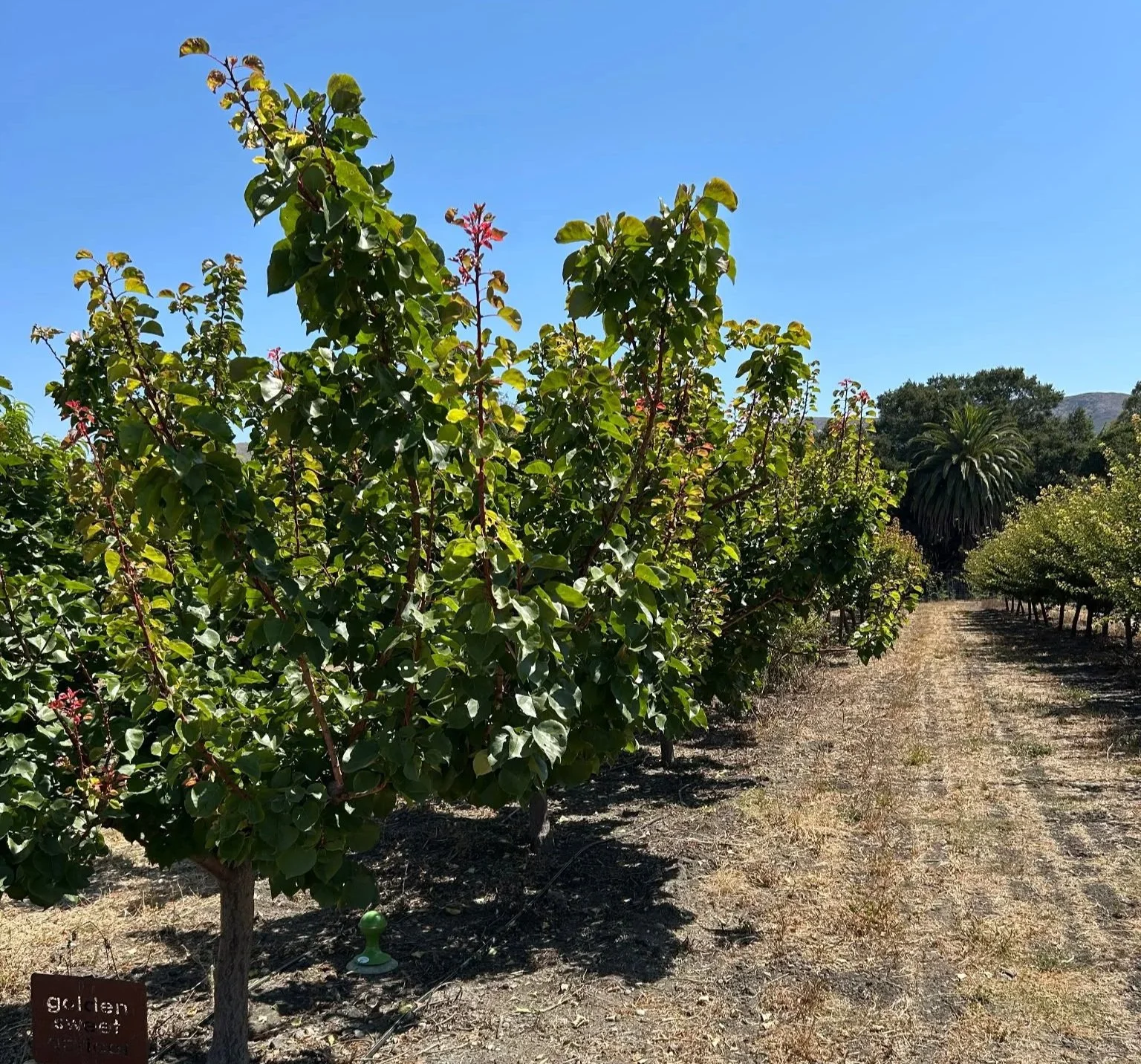
Apricot trees planted by students, staff and faculty in 2022.
Cal Poly President Jeff Armstrong’s current vision does not honor the Master Plan 2035. Instead, he wants to lease this land to an off-campus developer to build a hotel, restaurants, senior living space, mixed use residential areas, a theater, etc. Basically, this is a way to create more revenue for the university. A direct quote from the proposal states “The site’s current role as a living classroom - home to lemon groves and active fields - is not just history, but an opportunity to create a bustling neighborhood, interwoven with industry partnerships and activation.” They literally are saying our living classrooms are history. They want to replace student learn-by-doing spaces with a “bustling neighborhood”. They want to pave over the fields Cal Poly’s reputation was founded on.
Cal Poly Agricultural Lands
Cal Poly, San Luis Obispo, has 280 acres of Prime farmland. About 200 of which is rangeland for grazing livestock. There are approximately 83 acres of agricultural and horticultural fields and over an acre of greenhouse spaces. These lands are right on campus and easily accessible for students and staff from the campus core and classrooms.
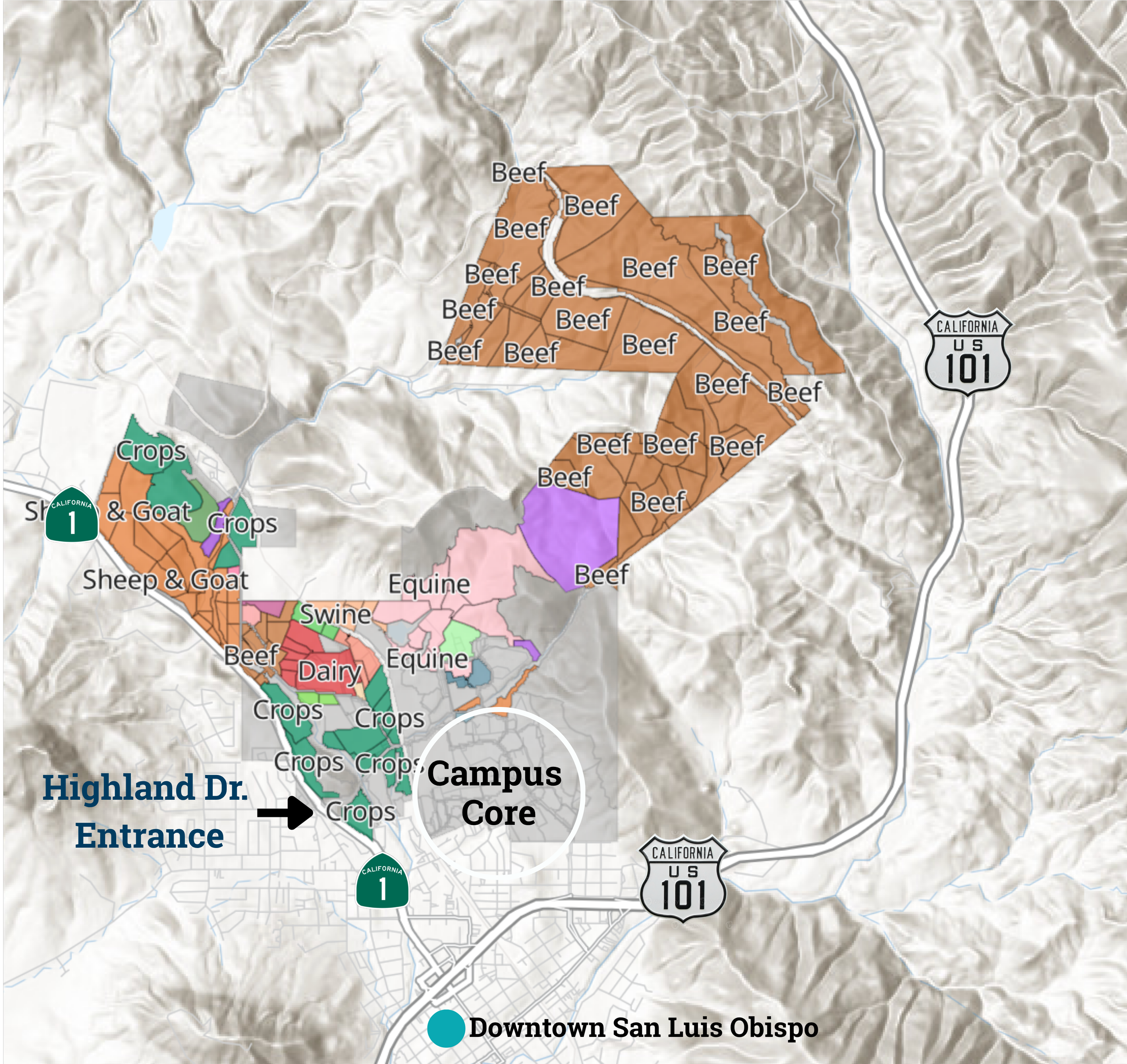
Modified map from Cal Poly Working Lands Mapping Project Documentation showing Cal Poly’s 280 acres of prime agricultural lands, with key crops and activities adjacent to the campus core and easy access for students.
What is so special about this land? The map below shows the Highland Avenue entrance to the west side of campus off of Hwy 1/Santa Rosa St. Entering campus, you pass by 54 acres of Prime farmland that includes a 10-acre lemon orchard, row crop fields, and a new deciduous orchard that has fruit and nut varieties suitable for coastal climates. The administration’s proposal puts buildings and parking lots on these lands.
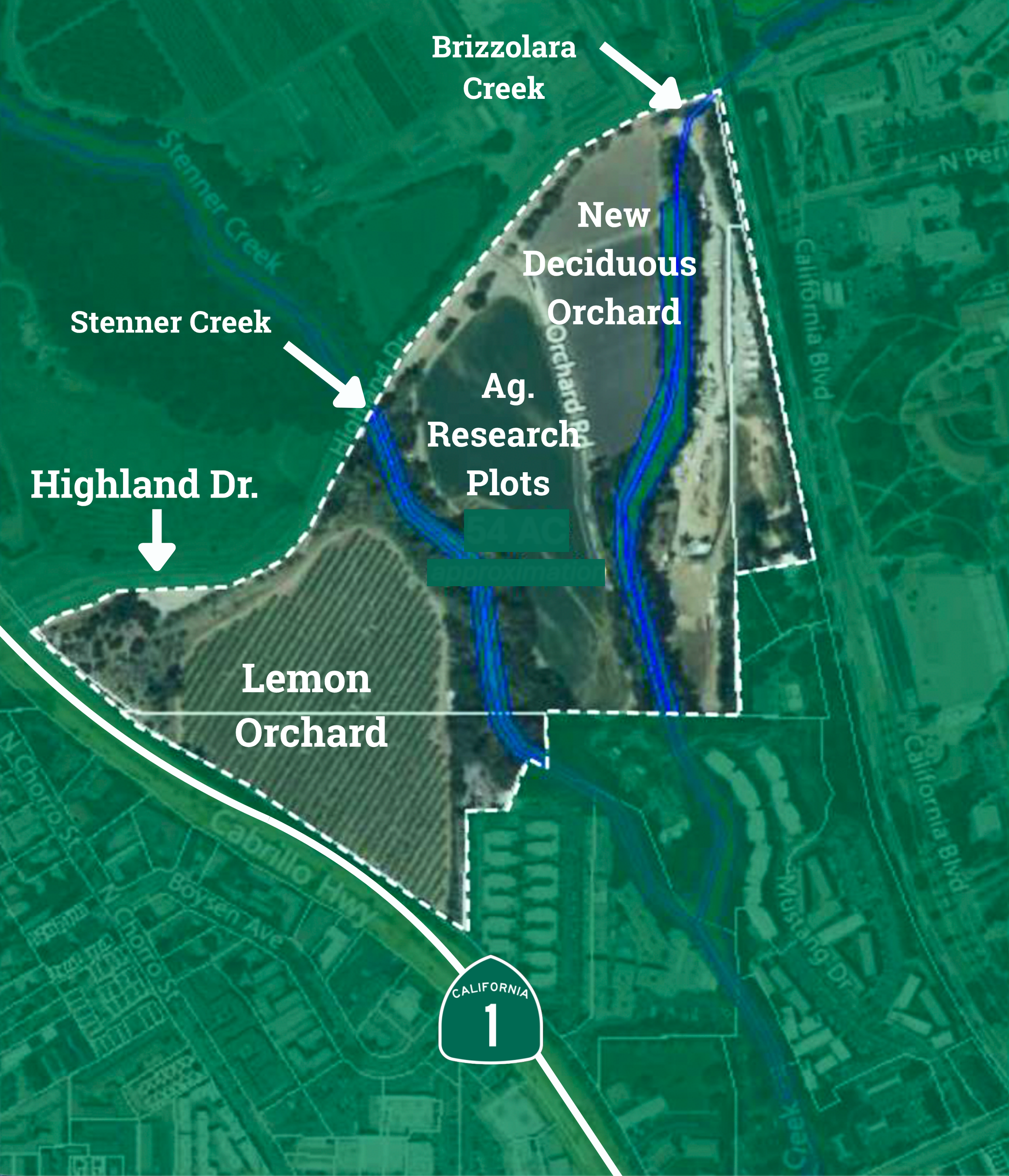
The Highland Avenue entrance to the west side of campus off of Hwy 1/Santa Rosa St. The white dotted line outlines the Class 1 Prime farmland.
Building on Prime Farmland
The area (outlined with a white dotted line above and in red below) is designated as Prime farmland. The map below is from Cal Poly’s Master Plan 2035. The legend is clear, P stands for Prime or Class 1 farmland. Other nearby fields are designated as Farmland of Statewide Importance, or Unique Farmland, or Farmland of Local Potential. Armstrong and the Cal Poly administration are well aware of these designations, but do not appreciate how critical a resource these lands are locally and statewide.
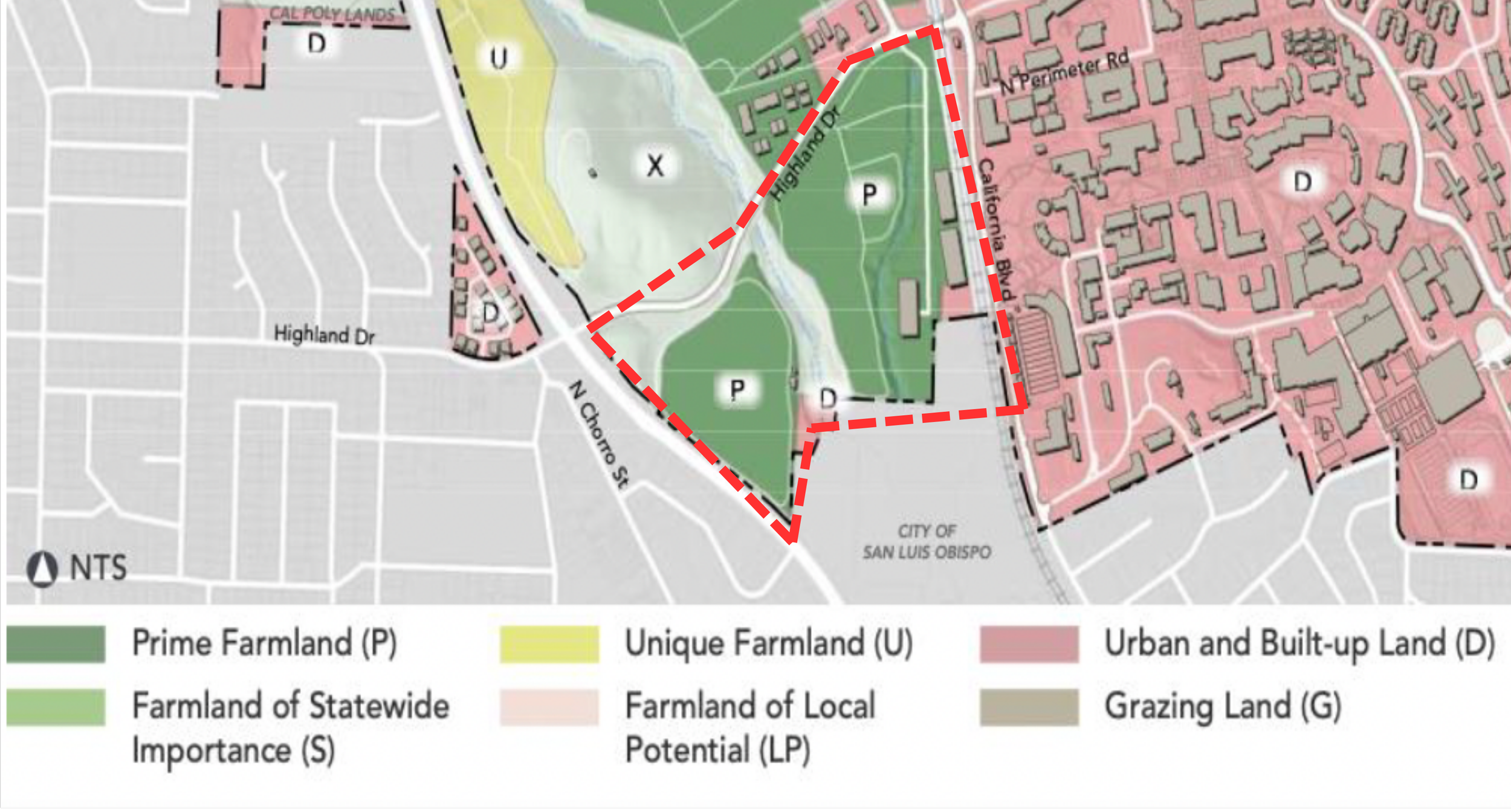
A map from Cal Poly’s Master Plan 2035. The added red dotted line outlines the Prime farmland that the Cal Poly administration is proposing to lease for urban development.
When I heard about this proposal, I had to speak up. I have a vested interest in the success of the Plant Sciences department and not just because I worked there for nearly 30 years. I’ve participated in and observed the learning that happens in our fields and orchards. Companies hire Cal Poly graduates because of the experiences they gain working in these living laboratories. And as a human who likes to eat, I have a personal interest in keeping all Prime farmland in production and not paved over with asphalt.
Soil Designations
Note: If you want to skip the details (not recommended), scroll down to the What Can You Do section below.
The terms soil, topsoil, arable land, and prime agricultural land are not just nouns. Prime or Class 1 farmland are not just a catchy descriptions. They are actual classifications of a non-renewable resource. They are specific definitions used to categorize land that in turn helps us determine how best to care for it.
I use the deductive method - moving from general to specific - as an organizing framework in my teaching. So here we go...
Earth
We’re on Earth. Its outer shell is the crust made up of rock ranging from 3 to 44 miles in thickness. The crust is thin. It represents less than one percent of the planet's radius.
Soil
The outermost layer of the crust is mostly covered with soil - the superficial unconsolidated and usually weathered outermost part of the crust or lithosphere of a planet.
On Earth specifically, soil is the surface layer where plants can grow. Soil averages 5 to 10 inches deep; in some places it can be 20 to 40 inches deep. This means soil is 0.0004% to 0.0001% of the crust’s overall thickness. All terrestrial life on this planet depends on a whisper thin skin of soil 10 inches thick.
Topsoil
Topsoil is a term that puts an anthropocentric spin on soil beyond simply just being. Topsoil is the surface soil including the organic layer in which plants have most of their roots and which is turned over in plowing.
As a term, topsoil changes the focus. Soil goes from a benign end product of planetary weathering that provides a resource in which plants grow on their own to a resource where we conduct food growing activities for our benefit.
Arable Land, a Non-Renewable Resource
Not all soil is suitable for growing plants, and not all topsoil is suitable for growing food, hence the next term: arable. Arable land is fit for and used for growing crops.
Needless to say, there’s not a lot of soil available for growing food and we often hear about the constant loss of arable land. The US loses nearly a square mile of farmland every day (Conservation Fund 2025). Another source puts it this way: Since the 1996 Farm Bill changed what growers decide to grow (seminal change in US farm policy), land in US farms has declined by 74.7 million acres or -8%. By far, pastureland declined the most, accounting for 88% of the total decline. The other two major farmland categories have also declined: woodlands by -6% and cropland by -2%. (Farm Doc Daily 2024). Another perspective: in the 5 year period between 2017 and 2022, the US lost, or farming ceased, on 20.1 million acres, an area equal to the size of Maine (American Farm Bureau Federation 2024). This isn’t just a US problem. Globally, the world has lost one-third (33%) of farmable (=arable) land since 1975 (Science Alert 2015).
It takes 1,000 years of natural processes to make 1 inch of topsoil (Scientific American 2014). So yes, arable land qualifies as a non-renewable resource.
Prime, Class 1 Farmland
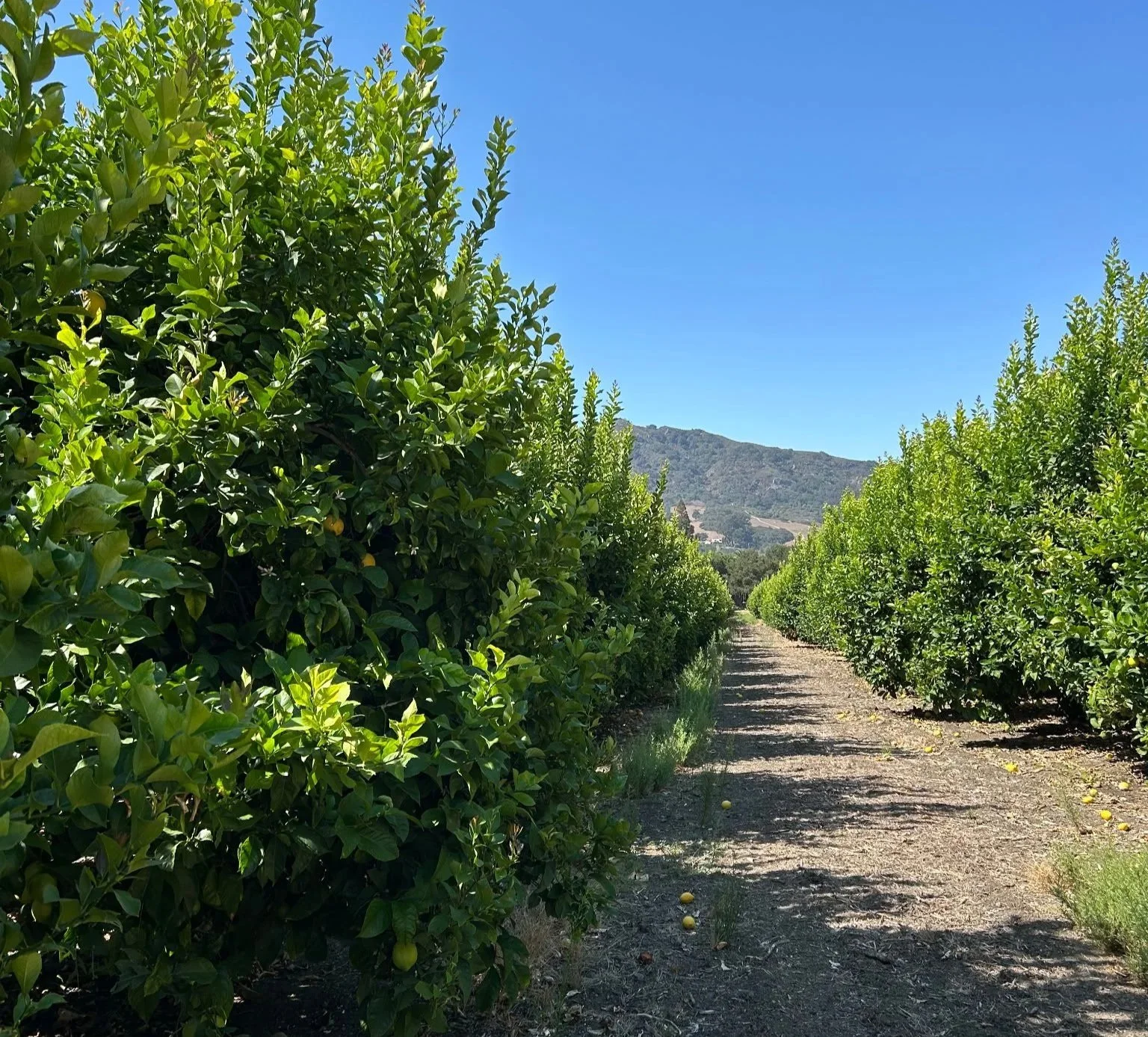
The lemon orchard has taught thousands of students about citrus production and pest management methods. Cal Poly, San Luis Obispo, 2026.
Not all arable lands are equal. Some are better than others.
In the U.S., agricultural lands are classified based on their use such as farming or ranching or even timber production. Specific regulations vary by state. In California, agricultural lands are classified based on a grading system of 1, 2, 3a, 3b, 4 and 5. Grades 1 and 2 receive the most planning protections and 3a land is considered as “best and most versatile” (BMV) land and also has planning protections.
The best of the best is Class 1 or Prime farmland and has the strongest state and local agency planning protections. Meaning, building on such soil – a rare, non-renewable and widely beneficial resource – is guarded against and in some cases prohibited. There are restrictions in place to protect these resources, such as:
Under CEQA, converting Prime farmland to non-agricultural uses triggers rigorous environmental review, and local agencies are intensely discouraged or legally challenged if they approve projects that destroy Prime farmland without major overriding public benefits and mandatory mitigation.
At Cal Poly, the Prime farmland designation is amplified by the fact that these fields are our laboratories for hands-on, learn-by-doing teaching, just as a chemistry lab, engineering lab, design studio, or theater are. All are cornerstones of a polytechnic university and Cal Poly’s learn-by-doing motto.
Would Cal Poly’s administration walk into a chemistry lab and say, hey, let’s turn this into a Starbuck’s for the town folk? No, that would be ridiculous and obviously antithetical to Cal Poly’s mission.
Also, teaching labs at California State Universities are officially categorized and designated by the state and the California State University system as “formal instructional and capacity space”. The state tracks physical facilities using formal space standards originally tied to the Coordinating Council for Higher Education, separating academic space into specific designations like lecture rooms, faculty offices, and teaching laboratories. Further, teaching laboratories are bound by specific state-level utilization formulas (measuring weekly student contact hours and station occupancy) to justify capital outlay and state funding.
Let’s Measure Some Student Contact Hours, Shall We?
Students, staff and faculty walk from the campus core and within 10 minutes they are working and learning and experimenting in the fields that grow many of California’s most important crops. I walked my students out there nearly every week for every class I taught for 29 years. Four different courses, some multiple times per year, averaging 40 to 50 students per course. That’s 6,670 students and ~70,000 weekly student contact hours of instruction in our agricultural fields over the course of my career. That’s just one professor providing learning experiences not available at any other four-year university campus in California. The diversity of crops and breadth of learning is unmatched across the US. And There are more than a dozen faculty that constantly use those fields for teaching. This equates to hundreds of thousands of accumulated student hours of unique learning and honing valuable skills.
Those skills are crucial to student success. They research, and experiment and make mistakes during the process, which is where the most important learning takes place. They gain experience that puts them head and shoulders above graduates from other campuses. That is a defensible definition of student success.
Round 2
This is not the first time we've had to protect our farmland. President Armstrong made a similar proposal in 2015, and the response was swift. Students mobilized, fought back and won. The university administration agreed not to build on the agricultural lands and to find other ways to satisfy the university’s need for buildings in the future. There is an existing signed document - the Master Plan 2035, but Armstrong is ignoring that agreement.
Cal Poly’s mission is to teach, not to make money off of leases and eliminate one of our most precious resources, a resource that is under duress all over California. We should be the example of how to conserve such a resource, not the example of how to forsake it.
It’s time to organize and put a stop to this, again. The faculty definitely have a dog in this fight, but the administration doesn’t listen to our protests because they believe they have a better understanding of student needs. We were successful last time because students, alumni, the community, concerned leaders in agriculture, The Farm Bureau, the planning commission and others rallied together as one voice and said no to Armstrong. We need that same level of outside organization and support again. It’s going to take a few folks willing to get together, make some calls, set up an organizational structure and develop a plan. Who will be a champion for Cal Poly and for agriculture? Are you ready?
We have to protect California’s farmland and stop the loss of Class 1 Prime acreage essential for training the next generation of food producers. Period. Tell Armstrong and the Cal Poly administration NO! Tell them to keep their hands off our teaching lands. Tell them to honor their previous promise not to build on a precious natural resource.
Steps you can take:
Spread the word amongst your network to get this message out to as many people as possible
Write your representatives: Rep. Salud Carbajal; Sen. John Laird; Supervisor Bruce Gibson; and Supervisor Heather Moreno. Tell them about this situation and that it needs to be stopped.
Write to Jeff Armstrong (jarmstro@calpoly.edu) and Brian Horgan (bhorgan@calpoly.edu) the Dean of the College of Agriculture, Food and Environmental Sciences. Tell them to honor their previous commitment. Tell them you want rare agricultural soils preserved in perpetuity. And tell them agricultural learn-by-doing requires large fields in active crop production to ensure competency for future generations of highly qualified food producers in this state.
And lastly, if you’re willing to step up and take a leadership role, email me at info@californiainsectscience.com. The time is now.
Sources
Conservation Fund - 4 Surprising Statistics Reveal What’s Really Happening to America’s Lands
Farm Bureau Intel - Over 140,000 Farms Lost in 5 Years
Science Alert - The World Has Lost a Third of Its Farmable Land in The Last 40 Years
Scientific American - Only 60 Years of Farming Left If Soil Degradation Continues
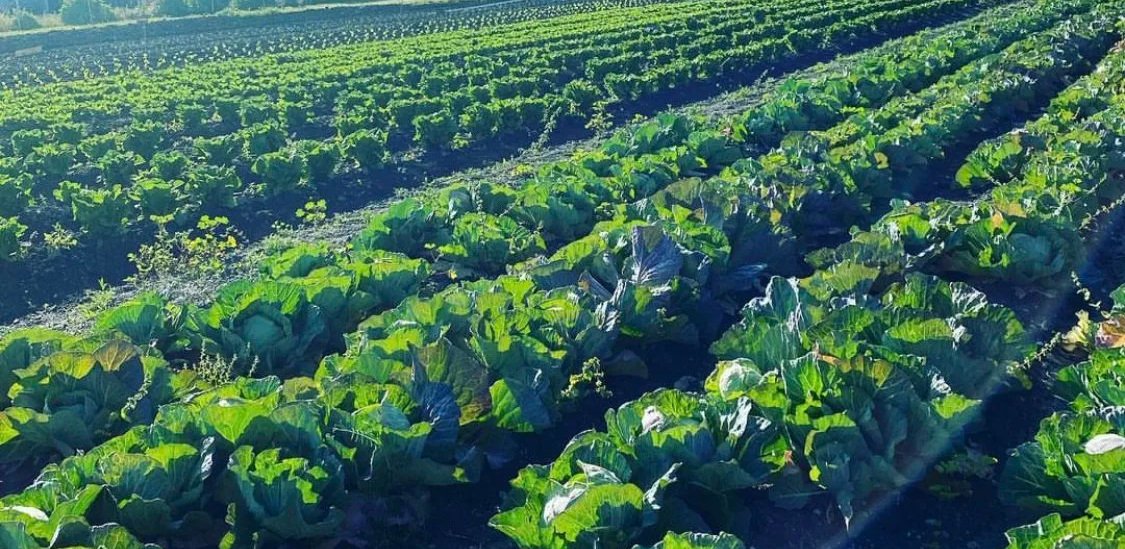
Cabbage grown on campus, Cal Poly, San Luis Obispo.