
Brown Recluse Spider Myths
Brown recluse spiders, Loxosceles reclusa, do not naturally occur in California. There is however, another species in the same genus, the desert recluse spider, Loxosceles deserta, that occurs in southeastern California and Arizona, but is medically unimportant, unlike its cousin.
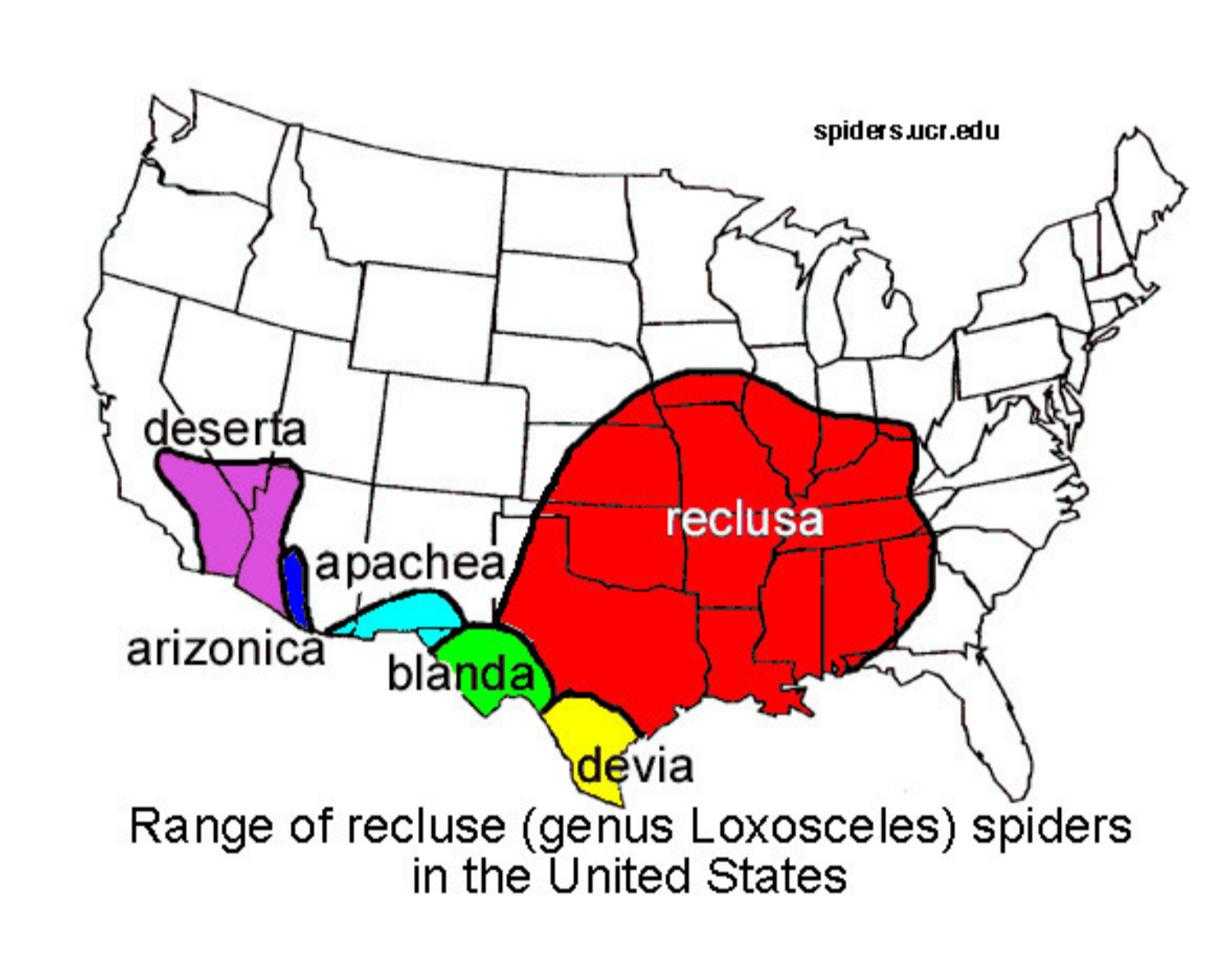
Map of the US showing where species in the genus Loxosceles exist. The large red section highlights where brown recluse - species reclusa- spiders are native. Map courtesy of UC Riverside, spiders.ucr.edu.
The Power of Myth
There is a persistent myth all over the US about brown recluse spider bites being the cause of skin lesions.
After telling students in my classes that brown recluse spiders do not exist in California I get rebuttals that go something like this:
“…but my bald aunt in Dinuba swears she was bitten by a brown recluse and had to have surgery for it”.
“...my friend in Redding had a doctor tell him that he was for sure bitten by a brown recluse”.
The involvement of brown recluse spiders in these instances is certainly incorrect. And invoking a doctor’s “diagnosis” is supposed to make the claim indisputable. Which is ironic because so often people want to disparage the medical community for a diagnosis they don’t like, but will go to the mattresses on their behalf for a diagnosis they do like.
Why I insist on weighing in
A long time colleague and friend, Rick Vetter, is an internationally acclaimed arachnologist and spider bite expert. He spent much of his career trying to train the medical community about spider bites; specifically how to avoid misdiagnosing brown recluse spiders as the cause. He has published articles in The Lancet and the Journal of the American Medical Association. He’s given multiple talks and trainings on this topic and contributed to public awareness campaigns such as the PBS SoCal article “The Persistent Myth of the California Brown Recluse”, the Medical Xpress article “Spider expert outlines expressions of skin conditions often misdiagnosed as brown recluse bites”, and the podcast Arthro-Pod EP 123: Brown Recluse Spiders with Rick Vetter.
Brown Recluse Identification
A true brown recluse spider bite is a dangerous thing and needs medical attention just like black widow bites. Proper diagnosis is crucial in order to receive appropriate medical treatment.
As always, proper identification is the first step in any pest management program. Always!
Identification of brown recluse is not straightforward because there are some variations among individuals. The most commonly used characteristic for brown recluse identification is the dark brown violin-shaped marking on the cephalothorax seen in the image below. However, it is not always reliable because it can be very light in some spiders.
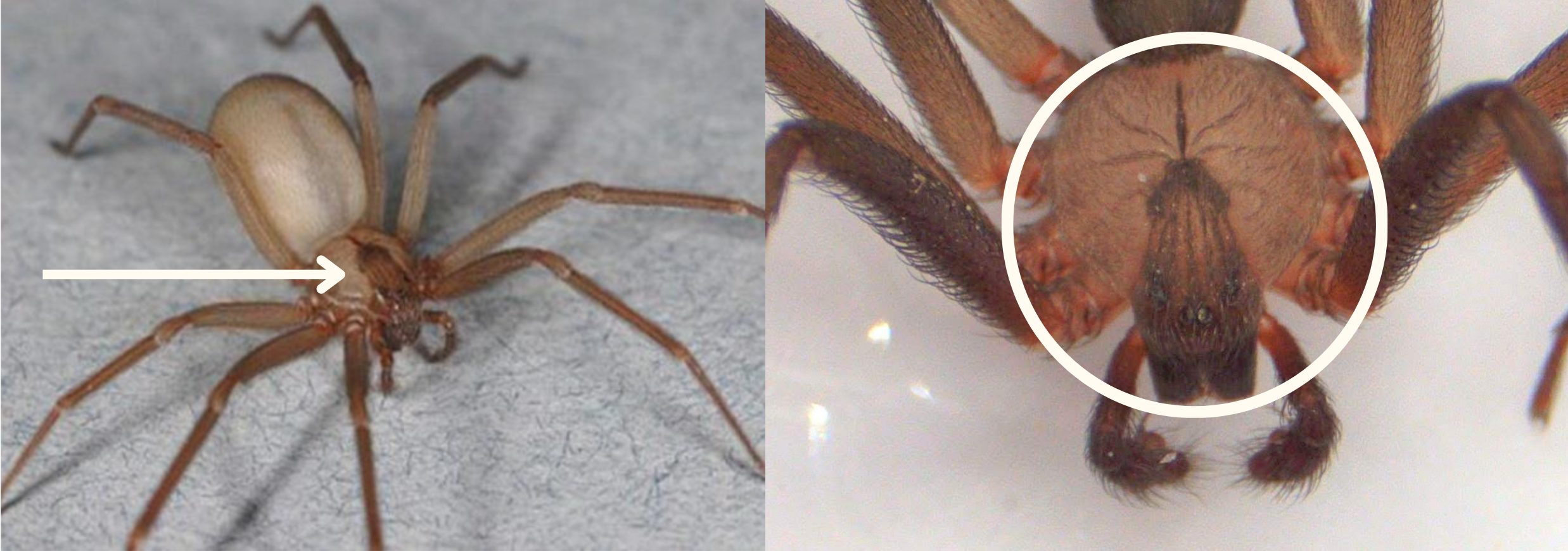
A habitus image of a brown recluse spider. The white arrow points to the location of the characteristic violin shape marking, the adjacent image shows a close up of the marking within the white circle. Photos provided courtesy of Richard S. Vetter.
Accurate identification lies in the pattern and the number of eyes. Brown recluse have six, equal sized eyes and they occur in three pairs (dyads) in a curved line across the front of the head. Most spiders have eight eyes and they occur in rows and different sizes.
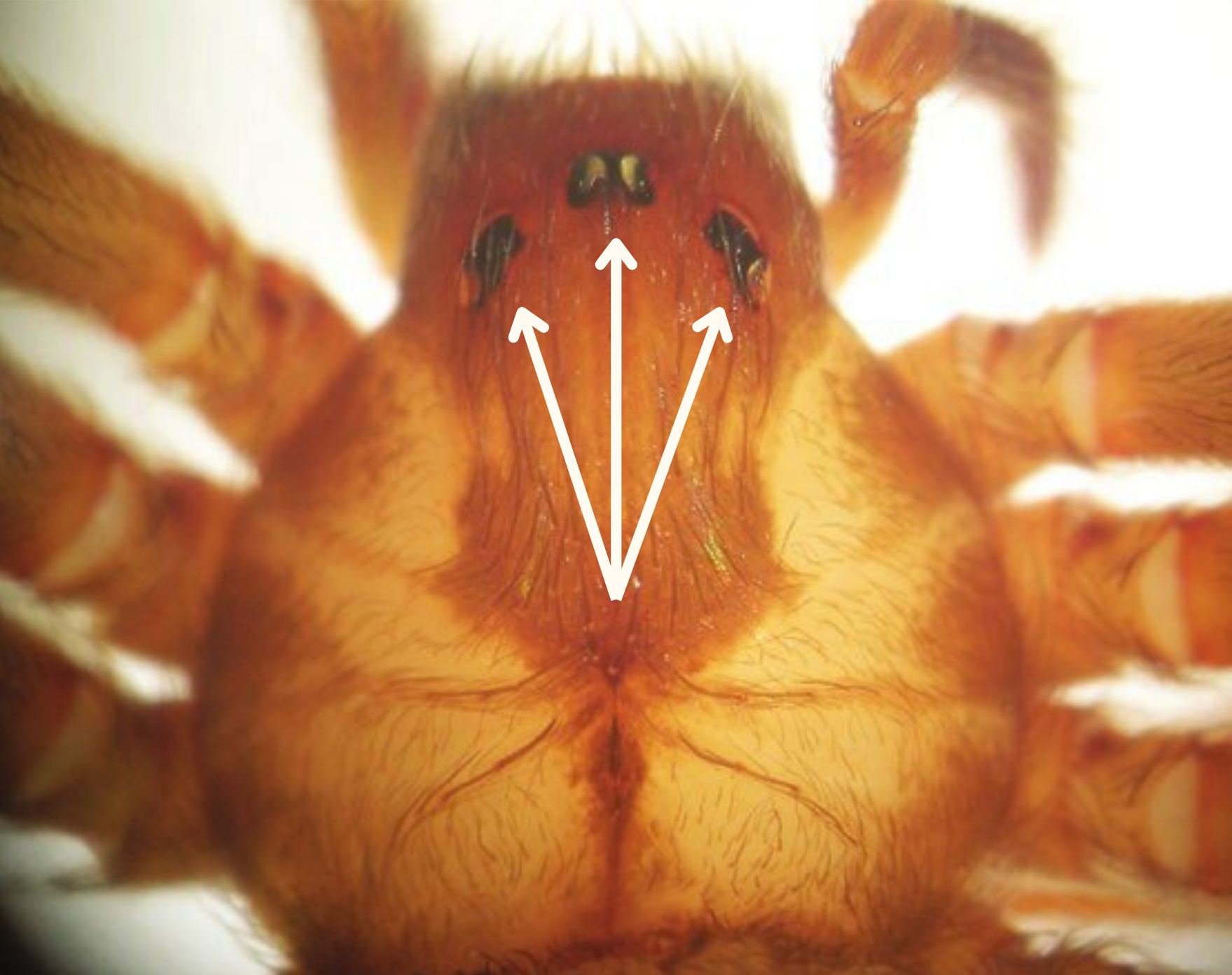
The white arrows point to the three pairs (or dyads) of equal sized eyes. If you see this eye pattern, along with a violin shaped marking, then you most likely have a brown recluse. Photo provided courtesy of Richard S. Vetter.
What else could it be if it’s not a brown recluse bite?
There are up to 40 different conditions that could be misdiagnosed as a brown recluse bite. Fungal infections, pyoderma gangrenosum, viruses, adverse drug reactions, other arthropod bites, thromboembolic phenomenon, Lyme disease, neoplasms, chemical burns, and necrotizing fasciitis, to name a few. Each of these potential causative agents require different treatments, therefore, a precise diagnosis is critically important and employing evidence-based detective work by the medical practitioner is crucial. Here’s the thing, the research cited below states that the most likely candidate for a skin lesion or necrosis is Methicillin-resistant Staphylococcus aureus (MRSA). That diagnosis should be at the top of the list before concluding a brown recluse bite, especially in nonendemic areas of the US, like California.
Evidence-based Diagnosis:
Brown recluse spider bites present with a distinct set of symptoms compared to black widow bites, MRSA infections, or other similar conditions. Those symptoms need to be considered during the diagnosis process in the examination room. Rick and his colleagues developed a mnemonic device to help medical folks determine the cause of a skin lesion – it’s called NOT RECLUSE. Clever. The citation is in the sources section below. These types of publications are targeted to medical practitioners in nonendemic areas in the hopes they will take more care in determining the true causative agent.
Bed Bugs or Brown Recluse?
There is one arthropod that is far more commonly encountered today than in the past, and whose bite might be mistaken for a brown recluse. Bed bugs. Bed bug bites flare up a few days after a bite and become reddened and often form a purulent papule that resolves in 1 -2 weeks. This is not the case for a brown recluse bite. A brown recluse bite starts to show symptoms within a few hours, has a reddened bulls eye around the puncture wound and goes flat and starts to decay in the center after a day or so. Another key difference is that bed bugs will bite you multiple times, often in a line along a leg or torso. With a brown recluse, there is typically a single bite, maybe two if the spider is trapped against your skin and responds defensively.
A last, desperate attempt to convince…
The other oft-repeated scenario involves relocations - people moving from the Midwest to California bring a brown recluse hitchhiker in a couch or other furniture and then someone gets bit after the move in. Boom! Another mic drop moment? Well, not so fast. There has to be more evidence than the possibility of a phantom spider from Kansas living in the La-z-boy. The best evidence is the actual spider itself. Yes, capture the offending spider in a jar, bring it with you to the doctors office and then have an expert (not a doctor, but an entomologist/arachnologist) properly identify it. But that almost never happens. And, the possibility of the culprit being a stowaway spider tucked into a couch also is not likely. In areas where brown recluse spiders live and thrive, homes can harbor dozens to thousands of such spiders, yet not one single report of a spider bite. Conversely, in areas where there are no brown recluse, there are reports of hundreds of brown recluse spider bites. Clearly, there is misdiagnosis going on.
The take home lesson is that if you are in California and you have a lesion on your skin that is painful and doesn’t look quite right, get proper medical treatment. But go in armed with the knowledge that it is almost certainly not a brown recluse spider bite. Be your own best advocate and insist on getting an accurate, evidence-based diagnosis so you can receive the appropriate treatment.
Sources:
Frithsen, Ivar L., Richard S. Vetter, Ian C. Stocks. 2007. Reports of Envenomation by Brown Recluse Spiders Exceed Verified Specimens of Loxosceles Spiders in South Carolina. Journal of the American Board of Family Medicine, pp. 483-488.. Doi: 10.3122/jabfm.2007.05.060221.
Johns Hopkins Medicine. Spider Bites.
Stoecker WV, Vetter RS, Dyer JA. NOT RECLUSE—A Mnemonic Device to Avoid False Diagnoses of Brown Recluse Spider Bites. JAMA Dermatol. 2017;153(5):377–378. doi:10.1001/jamadermatol.2016.5665.
Vetter, Richard S. 2003. Pediatric lawsuits: Brown Recluse Spider Bite Diagnoses and Lawsuits. Pediatric Emergency Care19(4):p 291-292, August 2003. | DOI: 10.1097/01.pec.0000092574.40174.ba
Vetter, Richard. 1999. Identifying and Misidentifying the Brown Recluse Spider. Dermatology Online Journal 5 (2): 7.
Vetter, Richard S. 2004. Myths about spider envenomations and necrotic skin lesions. The Lancet. Vol. 364(9433):pp. 484-5. doi: 10.1016/S0140-6736(04)16824-4.
Vetter, Richard S. 2018. Brown Recluse and Other Recluse Spiders. UC IPM.
Wendell, R. Preston. 2003. Brown Recluse Spiders: A Review to Help Guide Physicians in Nonendemic Areas.Southern Medical Association Journal, pp.. 486-490.